
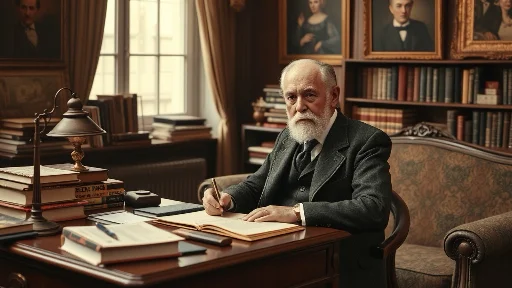
Sigmund Freud, the father of psychoanalysis, revolutionized our understanding of dreams, famously calling them 'the royal road to the unconscious.' In his seminal work, *The Interpretation of Dreams*, published in 1899, Freud proposed that dreams are not random nocturnal events but rather disguised fulfillments of repressed wishes. He believed that by analyzing dreams, one could gain profound insight into an individual's hidden desires, fears, and unresolved conflicts.
A cornerstone of Freudian dream theory is the distinction between manifest content and latent content. The manifest content is the dream as it is remembered and reported by the dreamer – the actual images, events, and narrative. In contrast, the latent content refers to the hidden, symbolic meaning of the dream, representing the unconscious thoughts and desires that are often too disturbing or unacceptable for the conscious mind to confront directly. Freud posited that the dream's true meaning lies in its latent content.
Freud described a process called 'dream-work,' through which the latent content is transformed into the manifest content to circumvent the ego's censorship. This process involves several mechanisms: condensation (multiple ideas compressed into a single image), displacement (emotional significance shifted from an important object to a seemingly trivial one), symbolism (unconscious thoughts represented by universal or culturally specific symbols), and secondary revision (the dream reshaped into a coherent story during waking recall).
Symbolism plays a crucial role in Freudian interpretation, with certain objects and actions believed to have universal symbolic meanings, particularly related to sexuality and primal urges. For instance, long, pointed objects might symbolize male genitalia, while containers or enclosed spaces could represent female genitalia. However, Freud also emphasized that personal associations and the dreamer's unique life experiences are vital for accurate interpretation, requiring the analyst to delve into the individual's history and current emotional state.
In a therapeutic context, Freudian dream interpretation aims to uncover repressed conflicts and childhood experiences that contribute to psychological distress. By helping patients understand the latent meaning of their dreams, analysts facilitate insight, allowing individuals to confront and integrate unconscious material into their conscious awareness. While aspects of Freud's theories have faced criticism and evolved over time, his pioneering work profoundly shaped psychology, psychotherapy, and continues to influence how we perceive the enigmatic world of dreams.