
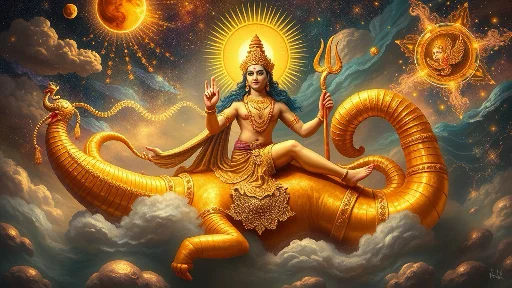
Hindu dream interpretation, deeply rooted in ancient Vedic traditions, offers a profound lens through which to understand the subconscious mind and its connection to the spiritual realm. Unlike Western psychology, it often views dreams not merely as random neural firings but as significant messages, omens, or reflections of one's karma and spiritual state. This practice has been an integral part of Hindu culture for millennia, guiding individuals in their daily lives and spiritual journeys.
The foundations of Hindu dream interpretation can be traced back to revered scriptures like the Atharvaveda, Brihadaranyaka Upanishad, and various Puranas, which contain extensive discussions on the nature of dreams and their prophetic significance. Ancient sages and seers meticulously documented and interpreted dream symbols, developing a complex system that considers not only the imagery but also the time of the dream, the dreamer's state, and their astrological influences.
A core principle is that dreams are often divine communications or reflections of one's karmic balance. Good dreams are believed to be blessings or indicators of positive future events, while bad dreams may serve as warnings or signs of unresolved karma. The influence of the three Gunas - Sattva (goodness), Rajas (passion), and Tamas (ignorance) - is also crucial, as they determine the quality and clarity of the dream experience and its interpretation.
Specific symbols hold particular weight in Hindu dream analysis. For instance, seeing gods or goddesses often signifies divine favor or spiritual progress. Animals like cows (prosperity), snakes (kundalini energy or danger), and elephants (strength, wisdom) carry unique meanings. Natural elements, colors, and actions within the dream are also meticulously analyzed to reveal their hidden messages, offering insights into health, wealth, relationships, and spiritual path.
Ultimately, the purpose of Hindu dream interpretation extends beyond mere curiosity. It serves as a spiritual tool for self-understanding, guiding individuals towards righteous actions (dharma), helping them mitigate negative influences, and fostering overall well-being. By paying attention to these nocturnal narratives, one can gain clarity, make informed decisions, and progress further on their path to spiritual enlightenment and a balanced life.